Why Does the Mind Behave This Way?
Why Does the Mind Behave This Way?
A simple and practical journey to understand the mind, thoughts, desires, and habits through the wisdom of the Gita.
Does your mind sometimes refuse to listen to you?
What is really going on in the mind behind Overthinking, Negative Thoughts, Desires, Distractions, and Bad Habits? Discover a simple way to understand, discipline, and guide the mind in the right direction through the wisdom of the Bhagavad Gita.

Does Your Mind Ever
Refuse to Listen to You?
Does Your Mind Ever
Refuse to Listen to You?
You know what you should do... So why does your mind keep doing something else?
Overthinking
A small thought keeps going around in your mind again and again. You don't want to keep thinking about it, yet your mind keeps returning to the same thought.
Negative Thoughts
Why do negative thoughts appear without being invited? Does every thought that comes into your mind really have to be true?
Bad Habits
You know that a certain habit is not good for you, yet your mind says — “Just one more time...”
Desires
One desire is fulfilled, and another one appears. Why does the mind never seem to feel satisfied?
Distractions
You want to focus on something important, but why does your mind keep wandering toward other things?
Emotional Reactions
Why do anger, anxiety, restlessness, or disappointment arise over something so small? How can you learn to pause before reacting?
Perhaps the problem is not that your mind is bad...
Perhaps you simply haven't yet tried to understand how your mind actually works.
A New Perspective
on Understanding Your Mind
A New Perspective
on Understanding Your Mind
Explore the different patterns of the mind through the teachings of the Bhagavad Gita, simple psychological concepts, and practical exercises.
Understanding Overthinking
What is the difference between Thinking and Overthinking? Why does the mind repeat the same thought again and again, and how can you begin to create some distance from it?
Why the Mind Keeps Wandering
Why can't the mind stay focused on one task? Instead of suppressing distractions, how can you practice bringing the mind back?
Negative Thoughts
Is every thought that comes into your mind true? Learn how to observe your thoughts and create some distance from them.
Understanding Bad Habits
Why do old habits become so strong? Learn to understand your habit pattern through Trigger, Reaction, and Replacement.
Desires and Attractions
Why do desires keep appearing again and again? Understand the difference between Need and Desire and learn to make more conscious decisions.
Doing Wrong Even When We Know Better
When we know what is right, why do we still end up doing what is wrong? How does the Bhagavad Gita view this inner conflict?
Why Do We Repeat the Same Mistake?
Learn to recognize your old pattern from Trigger to Reaction and Action, and practice interrupting that pattern before it repeats.
Finding Peace of Mind
Does peace mean having no thoughts at all? Explore the balance between expectations, control, and being present in the moment.
Training the Mind
Through the Bhagavad Gita's principles of practice and detachment, learn to guide the mind in the right direction instead of trying to suppress it.
Turning the Mind Toward the Divine Name
The goal is not simply to stop the mind, but to give it a higher and meaningful direction. Learn how the Divine Name, remembrance, and listening can become part of your practice.
“बन्धुरात्मात्मनस्तस्य येनात्मैवात्मना जितः”
When the mind is brought under control, that very mind can become a helpful friend.
But this book is not meant to be simply read.
Practical exercises are included to connect each topic with your everyday life.
Before You Read,
Take a Look Inside
Before You Read,
Take a Look Inside
Take a look at a few pages from the Ebook to get a feel for its language, topics, and practical approach.
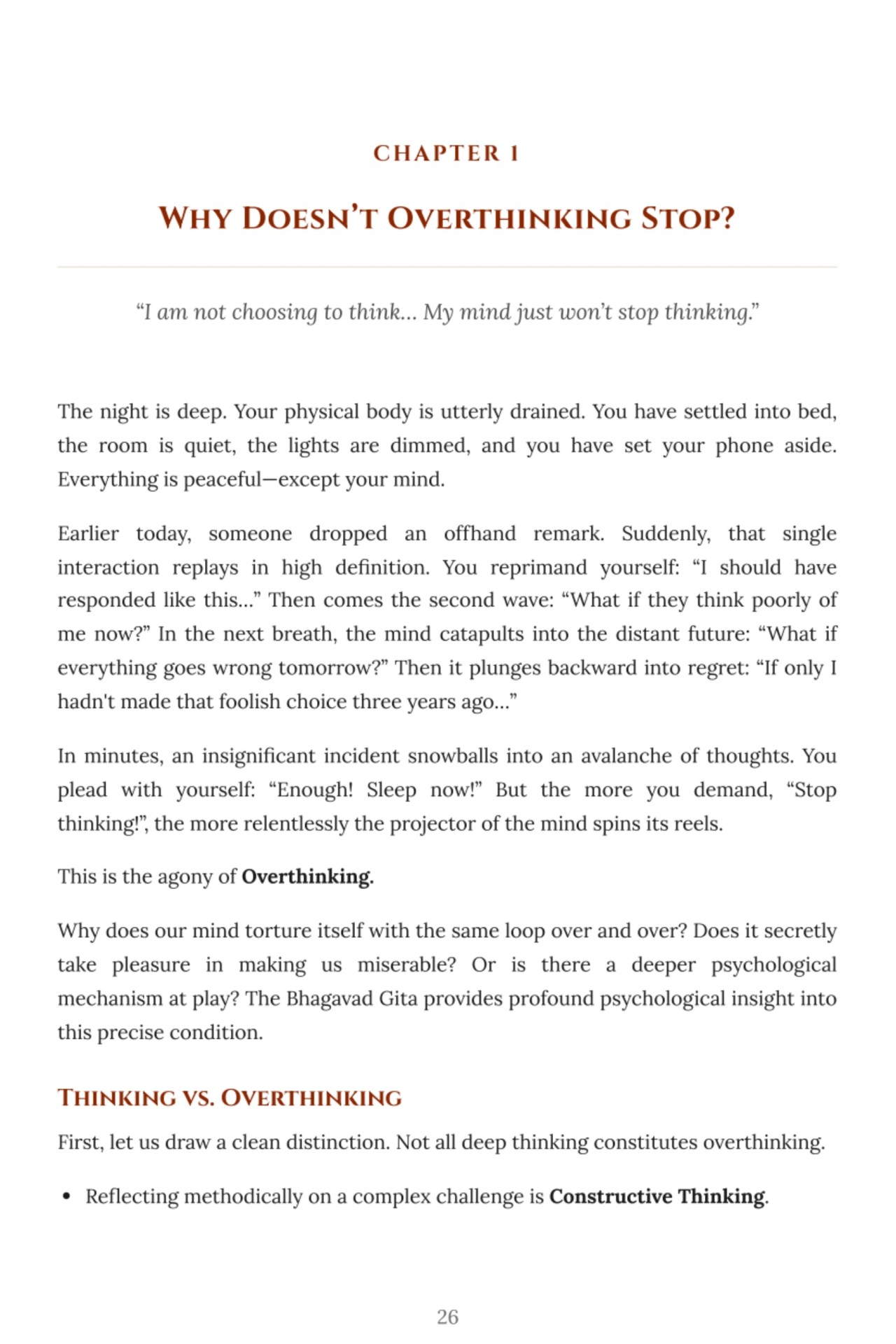
Why Doesn't Overthinking Stop?
Why does the mind keep thinking about the same thing again and again? This chapter offers a simple and practical way to understand overthinking.
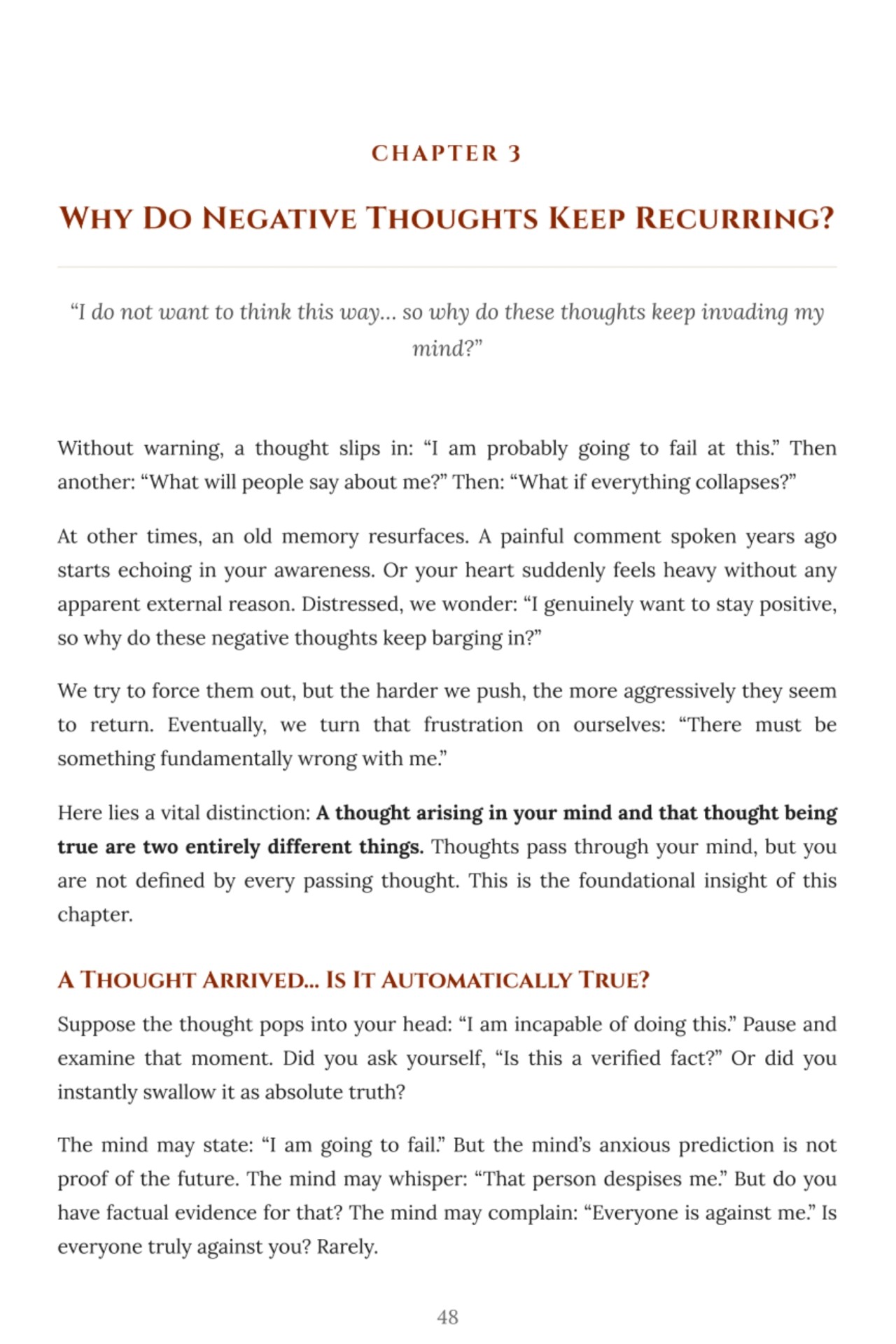
Why Do Negative Thoughts Keep Coming?
Having negative thoughts does not mean that every thought is true. This chapter offers a practical perspective on observing thoughts and learning how to respond to them wisely.
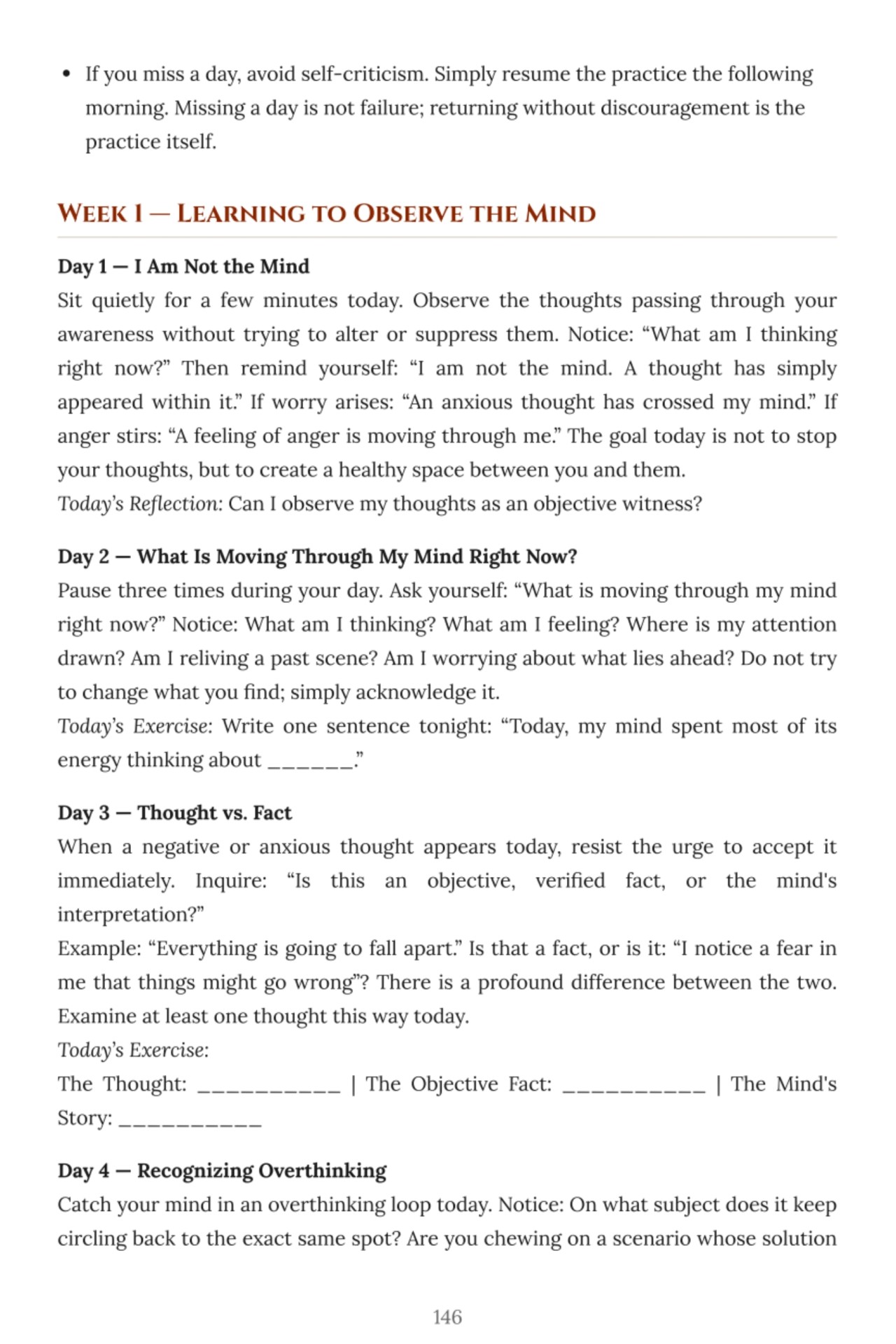
From Understanding the Mind to Practice
Begin a 30-day journey with small, practical exercises designed to help you observe, understand, and gradually guide your mind in the right direction.
Observe → Identify → Pause → Choose → Return
Understanding the mind is not just about reading. The journey moves forward through practice.Don't Just Read...
Practice with Your Mind.
Don't Just Read...
Practice with Your Mind.
A simple and practical 30-day journey to bring what you learn in this book into your daily life.
30 Days — Learn to Observe, Understand, and Guide Your Mind
Don't try to change your mind in a single day. Through small daily practices, learn to observe your thoughts, emotions, desires, and habits.
Observe Your Mind
Learn to observe your thoughts and mental patterns without immediately reacting to them.
Recognize Thoughts and Emotions
Practice understanding the difference between a thought, an emotion, and a reaction.
Understand Triggers and Habits
Identify the situations that lead you back to your old patterns.
Choose Your Response
Learn to create a small space between reaction and conscious response.
Guide the Mind in the Right Direction
Through practice, detachment, self-study, and remembrance of the Divine Name, learn to bring the mind back again and again.
Your 30-Day Journey
Each week focuses on one important aspect of the mind.
Learn to Observe the Mind
- I am not my mind
- What is happening in my mind right now?
- Thought or fact?
- Recognizing Overthinking
- What is within my control?
Thoughts, Emotions, and Habits
- Recognizing Negative Thoughts
- Creating distance from thoughts
- Naming your emotions
- Identifying your Triggers
- Pausing in the middle of an old habit
Desires and Decisions
- What is my desire?
- Creating distance between desire and decision
- Recognizing Immediate Rewards
- Practicing shifting your attention
- Ten seconds before making a decision
Peace and the Right Direction
- Gratitude
- Returning to the present moment
- Giving the mind a higher subject
- Why do I repeat the same mistake?
- Practice and detachment
Turning the Mind Toward the Divine Name
In the final days, the practice moves toward giving the mind a higher and meaningful direction — through the Divine Name, listening, remembrance, and integration with your daily responsibilities.
The goal is not that after 30 days, no thought or desire will ever arise in your mind.
The goal is — when your mind wanders,
you know where to bring it back.
Start Your Journey to
Understanding Your Mind
Start Your Journey to
Understanding Your Mind
A simple ebook, practical exercises, and a 30-Day Mind Practice — so you don't just read about the mind, but begin to observe it and guide it in the right direction.
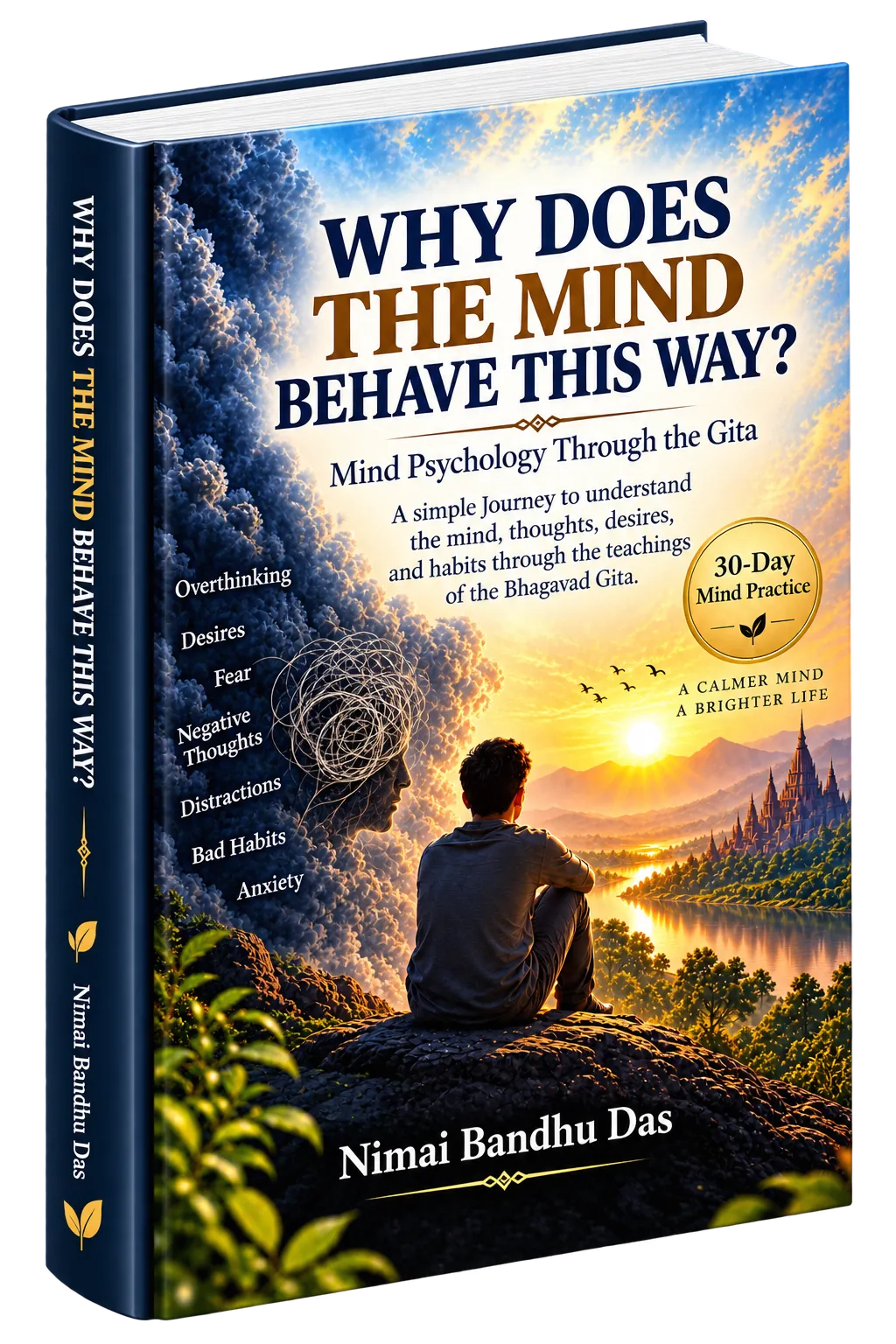
Why Does the Mind Behave
This Way?
Mind Psychology Through the Gita
What You Will Get:
Complete “Why Does the Mind Behave This Way?” PDF ebook + Online Reading
Simple and practical explanations based on the teachings of the Bhagavad Gita
30-Day Mind Practice — small daily exercises
Practical tools to understand Overthinking, Thoughts, Desires, Habits, and Distractions
Practices to observe your mind and consciously choose your response
Understanding practice, detachment, and remembrance of the Divine Name to guide the mind in the right direction
This Ebook Is For You If...
Your mind repeatedly gets caught in Overthinking.
You want to better understand your Thoughts and Emotions.
You are finding it difficult to break an old habit.
You want to understand the relationship between desire and human decision-making.
You want to understand the teachings of the Bhagavad Gita and connect them with your daily life.
You don't want to suppress your mind, but learn to guide it in the right direction.
No promise to completely transform you.
Just a beginning... to understand your mind.
Read. Practice. Observe. And gradually learn to guide your mind in the right direction.
Don't Just Learn About the Mind...
Learn to Guide It.
Don't Just Learn About the Mind...
Learn to Guide It.
“Why Does the Mind Behave This Way?” presents the teachings of the Bhagavad Gita in simple language, connecting them with everyday situations and practical self-reflection exercises.
The Gita's Perspective
Explore the mind, senses, intellect, desires, action, practice, and detachment through the teachings of the Bhagavad Gita.
Connected to Modern Life
Overthinking, Distractions, Negative Thoughts, Bad Habits, and Desires are explained through relatable everyday examples.
Practical Mind Practice
Instead of simply reading ideas and moving on, you get an opportunity to observe your mind and practice through small, practical exercises.
This book does not aim to present the Gita and modern Psychology as the same thing.
The book presents general psychological concepts and the teachings of the Bhagavad Gita while keeping their different contexts in mind.
The aim is to connect classical teachings with questions we face in modern life and use them as tools for self-reflection and daily practice.
Begin by recognizing what is happening within your mind.
You do not have to react immediately to every thought or impulse.
Practice choosing your next step with discernment.
When the mind wanders, learn to bring it back to the right direction again and again.

You May Have Some Questions...
You May Have Some Questions...
Here are answers to some important questions you may have about this book.
Is this only a religious book?
Along with a spiritual perspective, it also includes everyday life examples and self-reflection exercises.
Is this a Psychology book?
Topics related to the mind, thoughts, desires, habits, and behavior are explained through the teachings of the Bhagavad Gita, everyday life examples, and practical exercises.
Its primary foundation is the teachings of the Bhagavad Gita.
Is any specific mantra required?
The purpose of this book is not to make any single practice mandatory.
In the final stages, remembrance of the Divine Name, listening, and remembrance are explained as spiritual practices for guiding the mind in the right direction.
You may adopt these practices according to your own faith and tradition.
Is this book suitable for Beginners?
It has been written in simple and accessible language.
Even if you have not studied the Bhagavad Gita in depth, you can understand its practical examples and exercises.
Wherever necessary, the relevant Gita teachings are explained with simple meanings.
What is the 30-Day Mind Practice?
Its core formula is:
Observe → Recognize → Pause → Choose → Return
How will I receive the Ebook after purchasing it?
After logging in, you can read the Ebook on your mobile, tablet, or computer and also download the PDF.
Start Your Journey to Understanding Your Mind Today.
Instead of simply trying to understand Overthinking, distractions, desires, and habits, begin a practical journey to observe your mind, understand it, and guide it in the right direction.
“The goal is not to defeat the mind.
It is to understand the mind, train the mind,
and guide the mind in the right direction.”